Saturday, March 14, 2020

Why N1N1 of 2009 is not like the Coronavirus


Remember the Last Global Pandemic? Probably Not

In 2009, a new strain of H1N1 influenza emerged. It did not cause anywhere near the disruption that Covid-19 has, and for good reason.
In late March 2009, two kids living more than 100 miles apart in Southern California came down with the flu. By mid-April, their illnesses had been diagnosed as being caused by a new strain of H1N1 influenza, aka swine flu. Flu outbreaks that had started a few weeks earlier in Mexico were soon ascribed to the new H1N1 as well. On April 25, with cases confirmed or suspected in 19 Mexican states and five U.S. ones, the World Health Organization declared the disease’s spread a “Public Health Emergency of International Concern.”
Swine flu has a history that makes health authorities pay special heed. In 1918, a variant of H1N1 influenza caused a global pandemic that is estimated to have killed as many as 50 million people, or 2.7% of the world’s population. After tests found H1N1 in two soldiers during a flu outbreak at the Fort Dix army base in New Jersey in 1976, the U.S. government jumped into action, with President Gerald Ford announcing a plan to vaccinate “every man, woman, and child in the United States.” That turned into something of a debacle, though, as the virus didn’t seem to spread beyond Fort Dix and the hastily assembled vaccine killed about 30 people.
In 2009, the reaction was more muted. In its public-health-emergency declaration in April, the WHO noted that the illnesses caused by the new H1N1 tended to be quite mild, with only one brief hospitalization and no deaths from the 20 confirmed U.S. cases. It also advised against any travel restrictions or border controls. When the U.S. government declared its own public health emergency the next day, Secretary of Homeland Security Janet Napolitano termed it more of a “declaration of emergency preparedness.”
It’s like declaring one for a hurricane. It means we can release funds and take other measures. The hurricane may not actually hit.
The hurricane did hit, although in some ways it was more like a tropical storm. The virus continued its spread, with the Centers for Disease Control and Prevention switching over on May 4 from counting confirmed cases to making estimates. As of May 5, 980 schools with 607,778 students had been closed in an effort to slow the epidemic. By late June, the CDC was estimating that 1 million Americans had contracted the disease. Meanwhile, on June 11, WHO Director-General Margaret Chan had declared that with the virus spreading in 74 countries “the world is now at the start of the 2009 influenza pandemic.” She also said that a vaccine was on the way, and that measures had been taken “to ensure the largest possible supply of pandemic vaccine in the months to come.”
By the time the vaccines became widely available in November, though, H1N1 was already on the decline. By January, many countries were canceling their vaccine orders, and a German physician and former Social Democratic politician was leading a campaign lambasting the WHO for declaring a “fake” pandemic to gin up business for pharmaceutical manufacturers.
That doesn’t seem fair, given that H1N1 did infect as much as 24% of the world’s population. The overall fatality rate was quite low, at about 0.02% of estimated cases — five time lower than the 0.1% average fatality rate for the seasonal flu — but that’s mainly because H1N1 had little effect on the demographic usually hit hardest by influenza: those 65 and older. For younger people, H1N1 was more dangerous than the seasonal flu, and in countries in South Asia and Africa with youthful populations the H1N1 pandemic really was a big deal, with the CDC later estimating a global death toll ranging from 151,700 to 575,400.
Still, that’s lower than the range that the CDC and WHO now put on the annual death toll from seasonal flu: 290,000 to 650,000. In the U.S., an estimated 60.8 million people contracted the new H1N1 virus from April 2009 through April 2010, 274,304 were hospitalized and 12,469 died. Because the CDC changed the statistical model it uses to make such estimates in 2010 that last number can’t really be compared to recent estimates of seasonal flu fatalities, which ranged from 12,000 in 2011-2012 to 61,000 in 2017-2018. But earlier estimates of overall flu-related deaths in 2008-2009 and 2009-2010 indicate that both flu seasons were less deadly than average.
I bring all this up of course because we are in the throes of new global virus outbreak, although current WHO Director-General Tedros Adhanom Ghebreyesus has so far refused to call it a “pandemic.” I’ll admit that I had entirely forgotten about the H1N1 pandemic until a couple of readers emailed to ask about its absence from a column I wrote last week about the risks posed by the new coronavirus.
Calling attention to 2009 pandemic has become a theme in pro-Donald-Trump circles, with extremely similar articles on PJ Media, Red State and Printly all claiming that President Barack Obama didn’t declare a public health emergency until the H1N1 outbreak had been raging for months (as seen above, the public health emergency was declared less than two weeks after the virus was discovered, although Obama did up that to a “national emergency” in late October). President Trump himself argued on Twitter that “the April 2009-10 Swine Flu, where nearly 13,000 people died in the U.S., was poorly handled.” Such charges are to some extent just “whataboutism,” a propaganda technique used heavily by the Soviet Union back in the day to divert attention from misdeeds and problems by calling attention to the purported misdeeds and problems of others. But comparing Covid-19 with H1N1 can shed some light on why the former has elicited the reaction it has.
For example: Why was H1N1 allowed to spread around the world more or less unchecked, while countries are going to far greater lengths to try to halt Covid-19? Why did the WHO call H1N1 a pandemic but not Covid-19? Isn’t 12,469 deaths a lot worse than the 26 that have been attributed to Covid-19 in the U.S. so far?


That last one is the simplest to answer: Covid-19 is near the beginning of its spread in the U.S., and thus cannot be compared with H1N1’s effect over a full year. If the U.S. death toll from Covid-19 is only 12,469 a year from now, that will likely be counted as a great success. The legitimate worry is that it could be many, many times higher, because Covid-19 is so much deadlier for those who get it than the 2009 H1N1 influenza was.
How much deadlier is still unknown, but of the cases reported to the WHO so far 3.4% have resulted in fatalities. That’s probably misleadingly high because there are so many unreported cases, and in South Korea, which has done the best job of keeping up with the spread of the virus through testing, the fatality rate so far is about 0.7%. But even that is 35 times worse than H1N1 in 2009 and 2010. Multiply 12,469 by 35 and you get 436,415 — which would amount to the biggest U.S. infectious-disease death toll since the 1918 flu. Hospitalization rates are also many times higher for Covid-19, meaning that if it spread as widely as H1N1 it would overwhelm the U.S. health-care system.
That’s one very important reason governments (and stock markets) around the world have reacted so much more strongly to Covid-19 than to the 2009 H1N1 pandemic. Another reason is somewhat more hope-inspiring. It’s that public health experts generally don’t think influenza can be controlled once it starts spreading, other than with a vaccine, whereas several Asian countries seem to have successfully turned back the coronavirus tide, for now at least.
Influenza can’t be controlled because as much as half the transmission of the disease occurs before symptoms appear. With Covid-19 that proportion seems to be lower, meaning that even though it’s more contagious than influenza once symptoms appear, it may be possible to control by testing widely and quickly isolating those who have the disease. This is one reason (there are others) the WHO’s Tedros won’t call it a pandemic. “The threat of a pandemic has become very real,” he said Monday. “But it would be the first pandemic in history that could be controlled.” H1N1 couldn’t be controlled in 2009, but was mild enough that this did not lead to disaster. Covid-19 is a much more dangerous disease that maybe, just maybe, can be stopped.
    This column does not necessarily reflect the opinion of Bloomberg LP and its owners.
    To contact the author of this story:
    Justin Fox at justinfox@bloomberg.net
    To contact the editor responsible for this story:
    Stacey Shick at sshick@bloomberg.net

    Wednesday, February 5, 2020

    Milton Friedman’s World Is Dead and Gone


    Economics

    Milton Friedman’s World Is Dead and Gone

    Five overlooked historical developments should reshape the debate between shareholder and stakeholder capitalists.

    The annual conclave of the rich and powerful this month in Davos, Switzerland, put the longstanding debate about the social responsibility of corporations front and center by proclaiming its official theme as “stakeholders for a cohesive and sustainable world.”
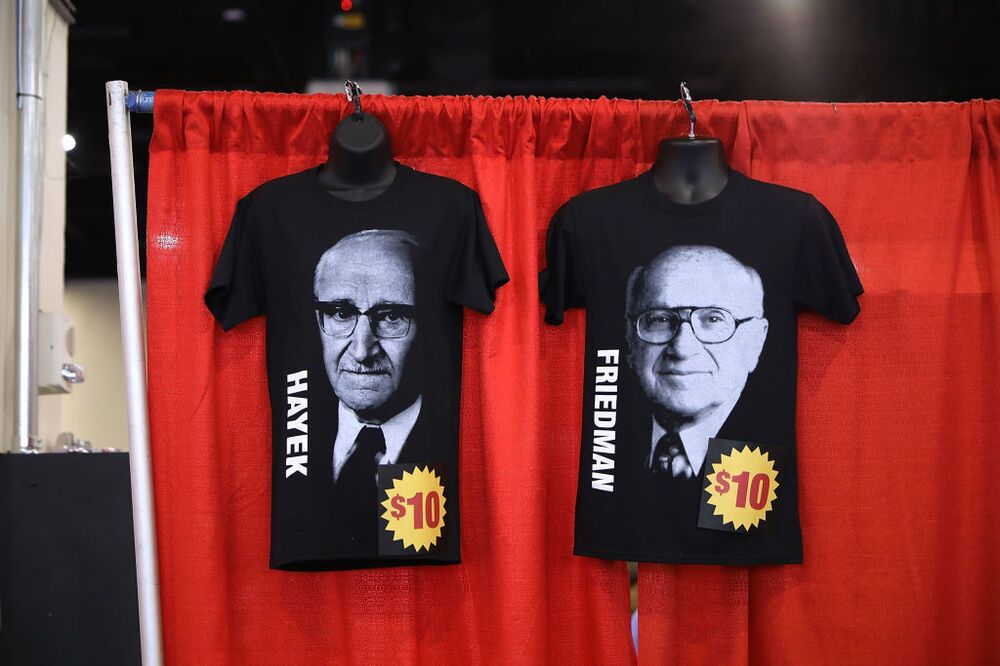
    By using the word “stakeholders,” the World Economic Forum confirmed that it’s taken sides in a debate rekindled last year by the Business Roundtable, a lobbying group representing chief executives of major U.S. corporations. The Roundtable had issued a statement highlighting a “fundamental commitment to all of our stakeholders,” including shareholders, clients, employees, suppliers and communities, thereby situating itself in opposition to the view of corporate responsibility made popular half a century ago by the economist Milton Friedman. Friedman had famously stated in a 1970 New York Times magazine essay that business executives who diverted corporate assets toward social goals were betraying their obligations to shareholders.

    >> Here is the link to the original article. The author overstates Friedman's case.
    >> http://umich.edu/~thecore/doc/Friedman.pdf
    >> The author also forgets that what Friedman is saying is much broader and not untrue.
    >> In each of these cases, the corporate executive would be spending someone else's money for a general social interest. Insofar as his actions in accord with his "social responsibility" reduce returns to stockholders, he is spending their money. Insofar as his actions raise the price to customers, he is spending the customers' money. Insofar as his actions lower the wages of some employees, he is spending their money.
    Yet the debate between Roundtable supporters and Friedman supporters, a main topic of panels and unofficial conversation at Davos last week, missed five key points.
    1. When Friedman was writing, the consequences of his view were more modest than they later became. In the 1960s and 1970s the regulatory state was often more interventionist than it is today — especially in industries such as transportation and telecommunications — and social norms were different. Before the deregulation wave of the 1970s and 1980s, arguing that a business executive should focus only on maximizing shareholder value thus may or may not have been wrong theoretically, but the practical impact was less significant. Whether business leaders pursued a narrow or broad definition of their responsibilities didn’t matter as much because government regulation constrained the consequences.
    2. In no small part because of Friedman’s influence, an extreme definition of capitalism has become dominant. By this definition, only perfectly competitive markets with minimally interventionist governments and business executives who maximized shareholder value should be considered capitalist. It’s a strange argument. I doubt that anyone would have said during the 1940s, 1950s or 1960s that the U.S. wasn’t capitalist, but somehow the qualification standards seem to have changed. I heard one person argue at Davos that regulating or even taxing carbon would be “anti-capitalist.” That’s nonsense. Virtually the entire range of policy options for more or less government action on climate change would not, if enacted, affect whether an economy remains capitalist.
    3. As Friedman’s worldview as taught in introductory economics classes became more dominant, policymakers emphasized the effect of incentives and individual skills. Economists focused on assessing how much more productive an individual could be if she faced a lower marginal tax rate or had more education. Studying, instead, how much more productive an individual could be if she worked at Company A instead of Company B, or lived in City X instead of City Y, went out of fashion. And yet the evidence over the past few decades shows the importance of the place-based perspective, with growing differences in productivity and wages for otherwise similar individuals working at different firms, growing differences in returns on capital across firms, and growing differences in upward mobility for people living in different cities.
    4. The evolving view of government’s proper role and the emphasis on individual-based policy instead of place-based policy coincided with fundamental changes in the global economy, especially a substantial expansion in the effective global labor supply, and the evolution of the computer era. Over roughly the same period, the U.S. experienced a disproportionate rise in political polarization, as a new analysis from the National Bureau of Economic Research shows. The authors of that article argue that diverging views among elites (which is plausibly about the role of government, though the authors don’t make that argument) may be the cause of the rapid rise in broader polarization relative to other countries. At the very least, it’s interesting that the country that has most forcefully adopted the Friedman-inflected approach to policy has polarized the most.
    5. Some people who want businesses to adopt a broad view of corporate responsibility argue that companies have to fill a gap left by the diminishing effectiveness of government. (They might not realize that Friedman addressed that issue in his 1970 essay.) Like the old saw about the child who murders her parents and then complains about being an orphan, however, the dominant paradigm of the past several decades has plausibly produced a dramatic rise in inequality and polarization, and that polarization in turn has made the government unable to function effectively. In other words, we have basically done this to ourselves.
    So what is the best pathway forward? There is no easy fix, but I like many recent ideas about making public investments and regulatory adjustments to encourage creation of business ecosystems like technology hubs, as has been done in Palo Alto, California; Austin, Texas; and Boston. That would require more government action than is likely in the near term. But as Friedman’s success in altering the dialog demonstrates, a first step is to be clear about what we should be doing, even before we’re capable of doing it. And an approach to policy making focused more on where we work and live seems vastly more promising than what we’ve tried over the past few decades.
      This column does not necessarily reflect the opinion of Bloomberg LP and its owners.
      Saturday, February 1, 2020

      The Impeachment of Donald Trump


      Were those two articles Impeachable Offenses?


      Start by asking, what is required by the constitution for an impeachment and removal from office of a duly elected president. The answer is; treason, bribery or High Crimes and Misdemeanors. and Alan Dershowitz ‪explains what this means. It is a very high bar.

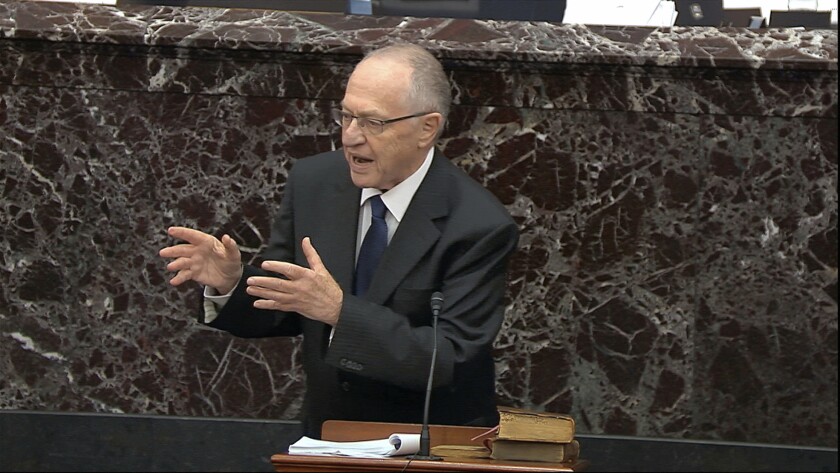
      Trump attorney Alan Dershowitz speaks Jan. 27 during the Senate impeachment trial of the president.
      Trump attorney Alan Dershowitz speaks Jan. 27 during the
      Senate impeachment trial of the president.
      (Associated Press)


      Alan Dershowitz's presentation was a master class in the constitution and why the 2 house articles are NOT impeachable offenses. To impeach on them makes the presidency a creature of Congress, not co-equal. This would set a terrible precedent. ‪I recommend viewing the entire presentation which is about an hour long.


      As for the question of witnesses; Let's assume that they completely show that the president attempted to get Ukraine to investigate the 2016 Democratic server, Burisma and the Biden's relationship to the company and the country. It is within the President's powers to investigate corruption. It is also withing his powers to withhold foreign aid, or in this case delay, for the purposes of his investigation. We have on tape Joseph Biden bragging about forcing the removal of a prosecutor who was looking into Burisma which was employing his son Hunter. I believe that Trump did ask for an investigation. No, it was not a crime. Therefore his action were not impeachable.

      As for the question of Obstruction of Congress, the only answer to that is that the House did not pursue a remedy in the courts. It is the courts to rule on differences between the legislative and executive. They injured themselves by not doing so.

      From the Democrats point of view they knew that they would never get 67 senators to vote to remove a duly elected president, expecially in an election cycle. So why puruse it. The answer is simple; to damage the president and the Republican senators politically. For the Republicans to allow anymore than the minimal time to this partsan impeachment effort would have been to allow the Democrats to weaponize impeachment and have the unchallenged use of this nakedly political process. It would have been political malpractice.

      For their efforts Romney has once again shown his complete lack of maturity. Collins will have lost her Republican base in Maine and not convinced any Democrats to support her as those Democrats will never forgive her for Kavanaugh. If the Republicans lose the Senate and do not win the House we will be even a more divided and fractious country. Our government will continue to be deadlocked and the threat of socialist style policies will advance a little bit closer to the core of our countries governance.

      Sunday, November 19, 2017

      Tax Debate 2017 and Trickle Down


      I recently got into a debate on Trickle Down Economics with a good friend - Again. Let's just call this person Goodfriend to make it easier to read the below.

      The debate was precipitated by a Twitter post from

      Alec MacGillisVerified account

      @AlecMacGillis

      Deep in the post was the primary article by WSJ writer Galston here


      This was mostly a memorial to the Ford exec Arjay Miller that looks at his job in the long term.
      The point I wished to pursue was that trickle down will not work and therefore any tax cuts will only go to the wealthy.

      My detailed reply to Goodfriend


      1-The premise of the article is that because the top 15 executives did this the policy failed. But what time period is he looking at? If it is the Reagan (bi partisan) tax cut, then that was a huge success.

      2- Our current Corp. tax rate is uncompetitive. Highest in the word and we tax income internationally/worldwide so if Coke makes $ in China we tax them as if that coke was sold in the US. This creates a cash horde overseas. All other countries tax in the country. This is known as a territorial taxation system. For example Samsung does not get taxed on TVs sold in the US.

      3- It might take a few years to see a benefit. CEOs should be free to invest in the US or not if that works for them.

      4- Even if the overseas money goes to execs, shareholders and dividends a lot of that money will find its way into the economy and produce benefits. Better than it staying offshore and doing nothing for the country.

      5- Trickle Down is the Dem epithet for the free market economy where benefits flow to all when there is economic freedom.

      The reply from Goodfriend to this was as follows

      There’s no proof that the money goes back into the economy, while there is proof the money gets stuck overseas or in their accounts or used to buy more shares of their corp

      If there is proof I’d love to see it also, I'd be curious to hear how raising taxes on lower and middle income Americans to pay for corporate taxes cuts results in more money in the economy, because lower and middle income people are the ones that would immediately spend it and put it back in the economy, likely in their own communities rather than offshore accounts or traded to other already wealthy people.

      My reply to Goodfriend

      http://www.heritage.org/node/18247/print-display


      Rather than a discussion of the above article I got another article to read

      https://www.brookings.edu/wp-content/uploads/2016/06/09_Effects_Income_Tax_Changes_Economic_Growth_Gale_Samwick.pdf

      This sort of sending articles back and forth doesn't give the time to actually debate one topic. I don't like it as it puts off the actual debate.
      Rather than argue how to debate I am going to respond to the article by Brookings and then refer back to the proof I was requested to provide in the Heritage piece.
      Here are the points raised and my responses.


      1) this seems to be a better argued and researched paper on the topic

      REPLY: In the abstract and saw this section.
      " if the tax cuts are not financed by immediate spending cuts they will likely also result in an increased federal budget deficit"
      This follows many of the left's criticisms. I find it a bit to strict because there is no allowance for increased economic growth due to lower taxes and less regulation.
      The CBO does not, by mandate, speculate on growth as a result of policy. The CBO and many on the left treats tax cuts based on a fixed income assumptions.
      There are so many caveats in this article it is hard to know where to begin. For example:
      " A fair assessment would conclude that well designed tax policies have the potential to raise economic growth, but there are many stumbling blocks along the way and certainly no guarantee that all tax changes will improve economic performance."
      Economics is almost impossible to test due to business cycles, wars, consumer mood you name it.

      What I sent you was an abstract from a speech, not a policy paper. The economic growth in jobs, GDP and (ironically) government revenues is the proof you asked for. There were three distinct periods where tax cuts for the rich did help the poor and the overall economy. The all ships rise on a incoming tide arguement. In the 1920s, the tax cuts from 70% to 25%, Kennedy tax reduction from 90% down to 70% and Reagan tax cuts in in 1981 from 70% to 50% and again in 1986 to 28%.

      2) I’m in favor of tax cuts but i think that it’s disingenuous to argue that corporate tax cuts will boost the economy if it is paired with tax increases to the lower and middle class, it may be good for the stock market but that’s not the same thing as being good for the economy. GDP can go up masking long term problems of income inequality. It seems to me like this tax plan is sure way to increase the already high wealth gap in our country

      REPLY: Disingenuous is a synonym for dishonest. The honesty of the intentions should be assumed until proven otherwise.
      I don't think that the pairing is necessarily the main point of this tax reform. The first thing to solve is our corporate tax rate. We have the world's highest corporate tax rate and it is riddled with special carve outs and exemptions that only some industries receive. The stock market is a barometer that tells what people think may happen. Growth in the economy (profits and jobs and personal income) follows the market by a year or two. If tax reform does not pass expect a big market decline. If it passes expect a large advance.

      Income inequality cannot be solved easily nor should government take radical steps to do so as unintended consequences will surely flow. The Obama administration from 2010 to 20018 sought to reduce income inequality and instead it increased greatly while giving around zero wage growth to the middle and lower income classes. The main points of the paper I provided show that government revenue actually grows with lower tax rates and also that the share paid by the wealthy increases relative to the burden on the middle class. Counter intuitive but that's what happened in each of these periods.
      More recently Clinton cut the capital gains rate and, guess what, government revenue climbed. I watched an ABC debate (Hillary versus Obama) where Charlie Gibson asked the candidate if he would raise the capital gains tax on the wealthy, even if this policy resulted in lower revenue for the government. Obama answered: “I would look at raising the capital gains tax for purposes of fairness.” It was that point that I knew he was an idiot and could not be trusted. Up to that point I had been a admirer. I loved his keynote speech at the Dem convention when he made his debut; "there's not a liberal America and a conservative America - there's the United States of America". That turned out to be truly Disingenuous.

      I recommend this WAPO opinion piece for background on fairness and Obamas 2008 debate position on tax fairness regardless of the cost.

      Final point - I just saw a interview with Steve Mnuchin (Fox New Sunday). He spoke on corporate tax rates being lowered as well as changing the US Corporate tax system from an International basis to a territorial basis. He said these HAVE to be permanent otherwise they will have no effect on corporate behavior. Because of the Byrd rule in the senate and the politics of reconciliation (where only 51 votes are required) the personal rates have to last only until 2025 when hopefully, if the economy grows, they can become permanent which takes 60 votes. A quick search on this VERY IMPORTANT FACT does not show it at all or if it does it shows it in an exclusively negative light. After all it is the Dems lock step refusal to participate in the process that makes this a problem. More people know about his wife than about the facts surrounding tax reform. Thanks Google Search for showing what is really important.

      This July Brookings article is instructive.
      https://www.brookings.edu/opinions/can-republicans-thread-the-needle-on-tax-policy/

      It shows how difficult this will be to do, especially with not all 52 Republicans actually Republicans. Imagine the party of lower taxes voting to NOT lower taxes.


      Tuesday, August 1, 2017

      Best of the Web - Schumer’s ‘Compromise’: No Tax Cuts

      Schumer’s ‘Compromise’: No Tax Cuts 


      Senate Democrats save negotiating time by ruling out everything not on their agenda.

      Captaion: Senate Minority Leader Democrat Chuck Schumer holding a copy of a letter he sent to Republican leaders on Tuesday.

      By James Freeman Aug. 1, 2017 4:53 p.m. ET


      “After Health Care Victory, Senate Democrats Seek Compromise on Tax Plan,” announces a New York Times headline today. Doesn’t that sound refreshing? Especially after the unanimous refusal of Democrats to support any of the three Senate bills considered last week to address the failure of ObamaCare, it would certainly be a welcome change to see a bipartisan approach to boosting economic growth. But the Times allows in paragraph six that “bipartisanship will not come easy,” which turns out to be more accurate than the headline.

      To their credit, Senate Democrats have generously decided to save everyone’s time by ruling out anything that deviates from their agenda of raising more government revenue and maintaining high marginal tax rates. In a six-paragraph note on “tax reform” signed by 45 of the Senate’s 48 Democrats, the pols don’t propose any particular measures to simplify or cut anyone’s taxes. But the signers, who include Minority Leader Chuck Schumer and Finance Committee Ranking Member Ron Wyden, make clear who should definitely not get a tax cut. The Democrats endorse an ill-advised comment by Treasury Secretary Steven Mnuchin —which he later walked back—that there would be ”no absolute tax cut for the upper class.”

      Depending on how one defines “upper class,” this could rule out relief for Americans paying nearly all of the country’s federal individual income taxes. In February the Tax Foundation highlighted IRS data showing that the top one percent of income earners pay more than 39% of income taxes, and the top 5% pay nearly 60%. The government has become so efficient at soaking the one percent—even as Democrats have become expert in stoking hatred against this hard-working group—that even a die-hard Sandernista would have to be impressed. The Tax Foundation explains:

      In 2014, the top 1 percent of taxpayers accounted for more income taxes paid than the bottom 90 percent combined. The top 1 percent of taxpayers paid $543 billion, or 39.48 percent of all income taxes, while the bottom 90 percent paid $400 billion, or 29.12 percent of all income taxes.

      You’d never know it from the standard harangues from Democrats about the rich paying their fair share, but the top quarter of income earners, which is perhaps a reasonable definition of the “upper class,” pay nearly 87% of federal income taxes. If the party’s most hysterical class warriors want to rule out relief for the top half of U.S. income earners, then they’re talking about the group paying more than 97% of income taxes. The bottom half of income earners are of course paying much less, but would surely welcome tax cuts just like people in higher brackets. They’re getting no assurances from Democrats. Today’s letter does vaguely call for “real relief for working families,” but elsewhere in the letter the Democrats signal that the status quo is acceptable when they write, “we believe that tax reform should not increase the tax burden on the middle class.”

      Just in case Republicans hadn’t gotten the point that the signatories had no interest in tax relief, the Democratic lawmakers rejected any “deficit-financed tax cut,” suggested no willingness to accept spending cuts to offset such a cut and added that “tax reform should be focused on providing a revenue base.”

       With the legislative calendar slipping away, Republicans should appreciate the favor they’ve just been done. As they draft a plan to boost economic growth and provide taxpayer relief, GOP lawmakers now know that the three Democrats who didn’t sign today’s letter—coincidentally all up for re-election in states Donald Trump won in 2016—are the only ones interested in negotiating. From the Wall Street Journal

      Sunday, March 12, 2017

      Peggy Noonan: House Republicans Repeat an Obama Error - with links to important articles


      Don't miss the links to the Caldwell and Eberstadt important articles

      Washington
      It is challenging for important Republicans on Capitol Hill now. They are leading their party at a time when it is changing and the country has changed. There are fissures in terms of what they believe and what they want. There is no shared, overarching sense of the meaning and purpose of the Republican Party, no agreed-upon blueprint from which to operate.

      Most of them know that something substantial happened in 2016, when half, and then considerably more than half, of the Republican base followed Donald Trump, along with a great many Democrats. But they are still uncertain of the meaning of the event. I suggested to a Capitol Hill figure last week that it was a populist wave and the future of the Republican Party is moderate populism. He answered that in fact the president, in his famous rallies, was often simply road-testing ideas and applause lines, adopting what got cheers and dropping what didn’t. He’d personally seen this. I thought: I’m sure you saw what you saw, but what you are noting is Mr. Trump’s cynicism when what matters is what the crowds agreed with—what they applauded. When he would say, seemingly in passing, that he won’t touch Medicare or Social Security, people are in enough trouble and a deal’s a deal, everyone—Republicans, Democrats—cheered. Because they are in financial trouble. And because they don’t trust Washington to be fair or wise in cutting or rejiggering essential programs.

      But the Hill figure did not believe that 2016 marked a change in political direction, and I suppose that’s lucky for him, because if he followed the prompting of a Trumpian base, his donors would not like it.

      Surely it is reasonable to conclude a big, burgeoning hunk of voters came forward in 2016 with a new definition of what popular, centrist GOP policies would look like—more economically nationalist and more socially and economically populist.

      The GOP’s first big legislative endeavor, the repeal of ObamaCare, has been understood as a classic fight between party leadership and the more conservative and libertarian wings, and there’s truth in that. I wonder if it will not also become a struggle between the leadership and the Trumpian core.
      The new bill lacks an air of appropriate crisis, a sense that it is responsive to this moment. I criticize it not from the right but I suppose the left: Eight years ago, I argued ObamaCare would be an unmitigated mess: “The system will be overwhelmed, the government won’t be able to execute, the costs will be huge.” I urged Mr. Obama to focus instead on Medicare; attack waste, fraud and abuse; come up with far-sighted cost saving measures—and, once this was accomplished with bipartisan support, make one little change: open the program to the uninsured under 65. Expensive? Yes. But simpler, cleaner, and better than destroying the health insurance system. The 2008 crash had occurred less than a year before. That was the moment American insecurity began to surge and reasonable pessimism take hold.

      Is it so different now?

      The two great sociocultural documents of this moment are by the political economist Nicholas Eberstadt and the journalist Christopher Caldwell .
      Mr. Eberstadt, in a Commentary piece titled “Our Miserable 21st Century,” writes that the year 2000 marked a grim milestone: “The Great American Escalator, which had lifted successive generations of Americans to ever higher standards of living and levels of social well-being, broke down around then—and broke down very badly.” He traces the economic factors, including dismal labor-force trends: “The plain fact is that 21st-century America has witnessed a dreadful collapse of work.” The top is doing fine but not the bottom: “21st-century America has somehow managed to produce markedly more wealth for its wealth-holders even as it provided markedly less work for its workers.”
      Physical health has deteriorated for a significant swath of white America, “thanks in large part to drug and alcohol abuse. All this sounds a little too close for comfort to the story of modern Russia, with its devastating vodka- and drug-binging health setbacks. Yes: It can happen here, and it has. Welcome to our new America.”

      He quotes a 2016 study reporting that nearly half of all prime-working-age male labor-force dropouts—some seven million men—take pain medication daily. That “adds a poignant and immensely sad detail to this portrait of daily life in 21st-century America: In our mind’s eye we can now picture many millions of un-working men in the prime of life, out of work and not looking for jobs, sitting in front of screens—stoned.”

      Mr. Caldwell, in First Things, focuses on the narcotics epidemic: “The scale of the present wave of heroin and opioid abuse is unprecedented. Fifty-two thousand Americans died of overdoses in 2015—about four times as many as died from gun homicides and half again as many as died in car accidents.” Salisbury, Mass., population 8,000, lost one resident in the Vietnam War. “It has lost fifteen to heroin in the last two years.” In four hours last summer 28 people in Huntington, W.Va., population 49,000, overdosed.

      The death toll “far eclipses” that of every previous drug crisis. Mr. Trump’s willingness at least to speak of the crisis surely helped him win, Mr. Caldwell observes: “In his inaugural address, President Trump referred to the drug epidemic (among other problems) as ‘carnage.’ Those who call the word an irresponsible exaggeration are wrong.”

      These two great pieces in great magazines deserve the deep, focused and alarmed attention of policy makers. We are in the midst of the kind of crises that can do nations in. It is pleasant to chirp, as Speaker Paul Ryan does, of “choice” and “competition” and an end to “paternalistic” thinking on health care. Is it responsive to the moment? Or does it sound like old lyrics from an old hymnal?
      I close with Tucker Carlson’s Wednesday night Fox News interview with Mr. Ryan. It cut to the political heart of the matter.

      Mr. Carlson questioned the new bill’s elimination of a tax on wealthy investors. “Looking at the last election, was the message of that election really, ‘We need to help investors?’ I mean, the Dow is over 20,000. Are they really the group that needs the help?”
      Mr. Ryan answered that the tax had been imposed by ObamaCare. “The trillion-dollar tax cut that this bill represents—that is part of the trillion-dollar tax increase that was in ObamaCare to finance ObamaCare.” It deserves repeal: “It’s bad for economic growth.”

      Mr. Carlson: “But the overview here is that all the wealth, basically, in the last 10 years, has stuck to the top end. That’s one of the reasons we’ve had all the political turmoil, as you know. And so, kind of a hard sell to say ‘Yeah, we’re gonna repeal ObamaCare, but we’re gonna send more money to the people who’ve already gotten the richest over the last 10 years.’ I mean, that’s what this does, no? I’m not a leftist, it’s just—that’s true.”

      “I’m not that concerned about it,” Mr. Ryan replied. Republicans promised to repeal ObamaCare, and they are.

      Maybe he should be concerned.

      Copyright ©2017 Dow Jones & Company, Inc. All Rights Reserved.

      Wednesday, December 28, 2016

      Monitoring Your Credit Score and Credit Report


      Monitoring Your Credit Score
      and Credit Report

      Original Post
      http://guides.wsj.com/personal-finance/credit/how-to-monitor-your-credit-score-and-credit-report/
      • Tips

        • You're entitled to one free credit report, once a year, from each of the three credit reporting agencies -- Equifax, Experian and TransUnion.
        • Higher FICO scores mean lower interest rates and can save you thousands of dollars. Try to boost your score before you apply for a loan.
        • Order your free credit report at ANNUALcreditreport.com. Avoid sites like freecreditreport.com. 

        Set up a calendar alert and run one of the three report every 4 months.

        Bad credit can result in unfavorable interest rates that cost you thousands when you take out a mortgage, a car loan or a student loan. It could block you from leasing that apartment you’ve been pining for. And it can be a black mark on your record that even prevents you from landing your dream job.
        So it pays to know the essentials of your credit report and related score, the behaviors that can make your score rise or plummet, and the services that help you monitor your credit.
        Your credit report is a summary of your borrowing and repayment history—any new accounts, closed accounts, unpaid bills, late bills, and other activity. If you have a loan, mortgage or credit card, it will show up here. Your credit report provides the basis for your credit score.

        Your credit score (also called your Fair Isaac Corp. (FICO) score) is a three-digit number between 300 and 850 calculated from a formula that’s designed to gauge your creditworthiness. The three main credit-reporting agencies (Equifax Inc., Experian PLC, and TransUnion) buy the formula from Fair Isaac. The bureaus use your personal data and crunch the numbers differently, so your score will vary slightly at each agency. When a lender considers your application for credit, they turn to one (or all) of the credit agencies for your score, which indicates your reliability as a borrower.

        Here are a few ingredients of a credit score:
        • Payment History: Whether you pay your bills on time, including credit cards, student loans, utility bills, or any other lender or service provider that reports to the big three agencies. Getting this right is easy: don’t blow the due date.
        • Amounts owed: The breakdown of your credit balances, and how they compare to the limits of what you’re allowed to take out. If you’re maxed out, it can hurt.
        • Years of credit: The age on your accounts. The longer your credit history, the better lenders can gauge your ability to repay. Unfortunately, the formula knocks young borrowers who don’t have an established, detailed history.
        • New credit: How many accounts have you opened recently, and how many lenders have inquired about your credit? The more activity, the more it appears you’re about to go on a debt binge.
        • Types of credit: The mix of accounts you hold, such as auto loans, credit cards, student loans, or mortgages.

        In general, higher credit scores equate to lower interest rates, meaning less cash you’ll have to fork over during the life of a loan. Recently, credit experts think any score above 720 will get you the optimum interest rate. In 2007, the national average FICO score is 723, and 58% of Americans have a score higher than 700, according to Fair Isaac.
        Remember that your credit score is important, but it’s not the sole factor in whether you get approved for a loan, credit card, or other forms of credit. Most lenders also look at your annual income, employment history, and other factors.

        With many consumers worried about shaky credit—especially with the threat of identity theft and credit card fraud—many financial institutions, companies, and the credit bureaus themselves are pitching products that guard your credit. Their credit monitoring services watch for new accounts, a surge in balances, or other changes to your accounts. Some will produce detailed reports about your credit score and suggest ways to make it more attractive to lenders.
        Don’t confuse credit monitoring with identity theft protection. Credit card fraud is just a piece of the larger problem of identity theft. Paying someone to monitor your credit will not halt identity theft or unauthorized uses of your Social Security number or other personal data, although it can help you detect problems before they escalate.

        Do You Need Credit Monitoring?
        The thought of a thief running up huge credit-card debts in your name is frightening. But credit-monitoring firms are banking on that fear, especially if you’re already a victim of a data breach. Before you shell out $100 (or more) per year for a credit watchdog, make sure you’re doing it for the right reasons. Maybe you know that you won’t keep adequate watch yourself. Perhaps you’re applying for a mortgage and want to make sure your credit remains pristine. Or you could just be obsessed with the idea of credit fraud. If so, credit monitoring might be worth the peace of mind.

        If you’re on the fence about whether you need credit monitoring, consider these self-serve approaches for protecting your credit:

        Watch your bank and credit card statements for fishy transactions — Make a habit of scanning your financial accounts daily, or at least weekly. Some creditors will even allow you to set up your own free alerts to notify you when online transactions are made on your account or when a purchase exceeds a specified amount.

        Keep an eye on your credit report — By law, you’re entitled to a free report every year from each of the three bureaus, so you might as well order a different one every four months. Scan it for abnormal activity, such as accounts or credit cards you didn’t open. You can order the report through each agency, or at annualcreditreport.com. Don’t fall for the add-ons; you just want the score.

        If you’re curious about your credit score, you might be able to access it for free. Many banks don’t offer this perk—instead they’ll package your score with inflated charts and graphs and make you pay for it. But it doesn’t hurt to ask for it. Another tack is to ask an inquirer (car salesman, credit card company, or landlord) for a peek at your score. They’ll pull your score before doing business with you, and might share it if you ask nicely.

        You can also take other common-sense measures, such as protecting your credit accounts online and shredding sensitive documents, to help prevent fraud. It’s good to know that you have the power to control your credit without paying someone else to do it. Remember, annualcreditreport.com is where to order your free credit report.

        How to Picking the Right Service and Boosting Your Credit Score
        You should base your buying decision on how comprehensive you want the monitoring to be and what you’re willing to pay for it. If you’re conscientious about your credit, there are many common-sense steps you can take yourself to keep your credit healthy. In that case, credit monitoring may not be worth the extra money.

        The big three credit agencies all offer products that will try to detect fraud and generate your credit score. Each provides a variety of packages depending on how vigilant you want them to be. Many banks offer similar services — look around, you might be able to get a better offer through your financial institution. And the identity-theft players, like LifeLock and TrustedID, also pitch credit monitoring as part of their ID theft protection services.

        Make sure you consider the cost before signing on. Some services charge as much as $50 monthly to keep tabs on your credit, which can total $600 annually. Weigh that expense against your odds of suffering credit card fraud. By one estimate, identity theft touches 3 percent of Americans each year—with credit card fraud just a fraction of that number.
        Finally, watch out for the bureaus promoting fancy scores that purport to measure your credit risk by some reconfigured formula. You only want the FICO score, the same one lenders request. The other so-called FAKO scores—like Experian’s PLUS score, TransUnion’s TransRisk score or Experian’s Credit ScoreTracker—are money drains. They’ll just confuse you about where you really stand. If you just want your score, you can order it through Fair Isaac.

        If you’re merely looking to keep your credit in good health, it’s not too tricky. Limit your credit cards, set up automated payments to pay your bills on time, space out when you apply for loans and accounts, avoid maxing out your credit cards and carrying unpaid balances. And keep it up for years and years. In short, don’t go nuts with credit, and you should be fine.
        If you’re paying for credit monitoring or just doing it on your own, be sure to report any errors you spot in your report. Contact the agency that sent you the report—each of them has a process for reporting errors. Incorrect info can be damaging to your credit.